
Rising Stakes
The Carter Family Series · Book 4 · by B. A. Lumin
Chapter 1
The first morning at Goddard smelled like nothing, and that was the thing that made Candi homesick before she had done a single thing worth being homesick over.
Home had a hundred smells that fought each other for the same air—solder and cut grass, Mimi’s vanilla, the creek when the wind came from the wrong direction. The Space Flight Center had been scrubbed down to a clean, even nothing, the way a whiteboard looks after someone erases it too carefully and leaves only the ghost of the last equation. She stood outside a door marked LAB 4B and read the placard twice, because reading things twice was how she kept her hands from doing something nervous.
“You’re early.”
The voice belonged to a woman with silver threaded through dark hair pulled back hard, and a travel mug that said WORLD’S OKAYEST ASTRONOMER in letters worn half off. Dr. Eleanor Reeves. Candi had memorized the name off the program sheet the way she memorized constellations, so she wouldn’t be caught looking.
“The letter said eight,” Candi said. “It’s seven-fifty.”
“It did, and it is.” Dr. Reeves keyed the door. It clicked instead of creaking, which Candi decided she didn’t like. “Early is a data point. It tells me something about you before you have said a word.” She held the door with her hip. “Come see what you came for.”
The lab was smaller than Candi had built it in her head. In her head it had rockets. What it had instead was six workstations, a wall of monitors, a coffee maker with a hand-lettered sign that said IT OWES US NOTHING, and a hum under everything—computers in rooms she couldn’t see, air moving through ducts, the whole building breathing the way a big machine breathes when it is doing work it does not need to announce.
“Sit anywhere that is not Priya’s.” Dr. Reeves pointed at a chair with a cardigan draped over it like a flag planted on a mountain. “Priya defends her territory.”
Candi took the chair at the end, near the window, where she could see a strip of parking lot and, past it, a line of trees that were the wrong trees—too tall, too green, no corn behind them. She set her things out the way she set them out at home: the tablet squared to the desk edge, the leather journal with its stitched NASA patch, two pencils with erasers no one had bitten. She had a system. The system was portable. That was the entire point of a system.
The butterfly clip sat warm against her hair, and inside it Whisper stayed dark and quiet, docked, Bluetooth off, privacy mode holding the way she had left it in the check-in line. She had made herself a rule in the car on the way here and she meant to keep it: for two weeks, the work would be hers. Not hers-and-Whisper’s. Hers. She touched the clip once—habit, comfort—and did not tap it awake.
Other kids filtered in. A girl with a backpack covered in stitched planets—the one from check-in—claimed the cardigan chair and gave Candi a nod that meant I see you and I am deciding. A boy she recognized too: the one with the serious camera, the strap looped twice around his neck like he had learned the hard way what happens when you trust a single loop. He set a laptop down and a hard drive beside it, and then a second hard drive, and then a third, and lined them up by size without seeming to notice he was doing it.
“Backups of your backups,” Candi observed, before she decided whether to.
“I lost four months of dark-sky data to a corrupted card once.” He didn’t look up. “Now I’m unreasonable on purpose. Devon.”
“Candi.”
“I know.” He plugged in the first drive. “You’re the backyard-log kid. Ramirez told the room.”
“Dr. Ramirez talks a lot.”
“Dr. Ramirez notices a lot and says a little of it.” Devon woke his screen, and a photograph bloomed across it—a field of stars so dense and clean it didn’t look real, a smear of pale gas hanging in the middle of it like breath on cold glass. “That is eleven hours of exposure. Stacked. I chase the pretty ones.”
Candi leaned in despite herself. It was pretty. It was also, she noticed, a little bit of a lie, the way all pretty pictures were—the color pushed, the faint stuff pulled brighter than a human eye would ever see it.
“What’s it a picture of?” she asked.
Devon opened his mouth, and then closed it. “A nebula,” he said. “In Cygnus.”
“Which one? How far? What’s it made of? Is it lit from inside or is something behind it?”
“It’s beautiful,” Devon said, a little sharp now. “Not everything has to be a quiz.”
“Beautiful is where you start,” Candi said. “It is not where you stop.” She heard the flatness in her own voice, the know-it-all edge Mom was always gently sanding off her, and she felt her ears go warm. She had been here nineteen minutes and she had already done the thing.
Devon turned back to his drives. The pretty picture stayed on his screen, unanswered, and the small cold space it left between them stayed too.
They did real work by nine, and the real work saved her.
Dr. Reeves gave them the same thing the professionals got, which was the part Candi hadn’t fully believed until it was on her screen: raw light curves, straight from the archive, no one’s conclusions painted over them yet. Long ribbons of a star’s brightness, measured and measured and measured, flat lines that dipped when something crossed in front—a planet taking a bite out of the light on its way around.
“You’re a cohort,” Dr. Reeves told them, walking the row. “Cohorts share. Your group project is a set of TESS candidates—TOI-1452 is the interesting one, a super-Earth that might be a water world. Three of you will chase down whether the dips are real or the telescope hiccuping. That’s most of science, by the way. Deciding whether the interesting thing is interesting or whether you’re fooling yourself.”
Priya raised a hand. “And the rest of the time?”
“The rest of the time you find your own thing.” Dr. Reeves stopped at Candi’s station without seeming to choose it. “Some people wait to be handed a thing. Some people go looking in the archive at seven-fifty in the morning.” She tapped the desk once, the way Papa tapped a workbench when he wanted a tool to behave, and moved on.
Candi went looking.
She pulled Kepler data—old, deep, years of it—and let the systems scroll past, and told herself she was only browsing, the way you tell yourself you are only walking past the kitchen. KOI-7923 stopped her. A candidate super-Earth, maybe in the habitable zone, the temperature band where water could sit on a surface without boiling off or freezing solid. That alone was enough to make her sit up. But it was not what kept her.
She overlaid the transits, one on top of another, dozens of them, the way you would stack tracings of the same signature to see if the hand ever shook. And the hand shook.
The dips were not landing when they should. Each one was supposed to arrive on a schedule as strict as a train—the predicted ephemeris, the math that said the planet will cross the star at exactly this minute. But the crossings drifted. Early, then early, then late. A stagger in the rhythm, small enough that a person in a hurry would call it noise and move on.
She measured it three times, by hand, refusing to let the software round it for her. Two point three minutes. Off by two point three minutes from where the clock said it should be.
Her whole body went still, the stillness that came over her when a pattern showed itself—the stillness Mom called freezing mid-motion, the one that made Scott wave a hand in front of her face and say she is buffering. A planet does not wander off its own schedule for no reason. Something has to be pulling it. Something with mass, tugging it forward and letting it fall back, a second body no one had drawn on the map yet, hiding in the gravity where the light never showed it.
Invisible, she thought, because we keep looking at the light and not at the silence between the light.
Her hand went to the butterfly clip. It would take Whisper four seconds to confirm it. Four seconds, one tap, and she would know.
She put her hand back on the desk.
“No,” she said, under her breath, to no one, to the version of herself that always wanted the answer faster than she had earned it. She opened the leather journal instead—Renee’s stitching catching the fluorescent light—and she wrote it out in pencil, the whole chain of it, ingress times and residuals and the ugly honest error bars, until the reasoning stood on its own legs without anyone holding it up.
Then she raised her hand.
Dr. Reeves came, read the page over Candi’s shoulder, and was quiet for long enough that Candi’s ears started to burn again.
“Show me the timings,” Dr. Reeves said finally. Not nice work. Not good girl. Just: show me. Candi showed her. Dr. Reeves clicked through the stack twice, mouth flat, and then something moved at the corner of it.
“Transit timing variation,” she said. “Maybe. It’s the right size to be a second planet, and it’s the right size to be you wanting a second planet very badly. Those look identical from here.” She straightened. “So we don’t decide today. We watch it. Timing signals need a long baseline—more transits than you’ve looked at, more than are even in this file yet. Citizen scientists run these down all the time, the patient ones.” She looked at Candi the way Papa looked at a circuit that had done something clever. “Keep the feed. Take it home when you go. Keep watching the silence.”
Candi wrote keep watching the silence in the journal and underlined it once, and felt, for the first time since the door had clicked instead of creaked, that she might actually belong in the room.
The belonging lasted until lights-out, which was when the building stopped humming and the homesickness got loud.
The dorm room had two bunks, a desk under a window, and a poster of a galaxy that someone had half torn and taped back so the seam still showed. Her roommates were the two girls from the first afternoon—the one from Idaho, who didn’t snore unless she ate cheese and had eaten a great deal of cheese at dinner, and the one who hummed songs she never finished and talked about a cat back home named Rutabaga until she fell asleep mid-sentence.
Candi lay on the bottom bunk and listened to strangers breathe.
At home there was always a sound to hold onto. Scott narrating a war between his socks. Renee’s music through the wall, turned low, a bass line you felt more than heard. The dome’s motor if Papa was up late. Here there was a pipe ticking behind the drywall as it cooled, and an elevator bell somewhere far off, and two girls she had known for one day, and the enormous quiet of being the only person for six hundred miles who knew there was a dragonfly asleep in her hair.
She reached up to the desk ledge and found the little wooden box by feel. Pocket sky. Papa’s. She pressed the single button and pointed the lens at the underside of the top bunk, and home climbed onto the pale wood—the real home sky, tonight’s, the Big Dipper tilted exactly the way it tilted out her own back window, Polaris holding its point without being asked.
The old fear came up through the dark the way the creek smell came up through the dome slit at home—unwelcome, familiar, impossible to un-smell once it arrived. The fear had a sentence, and the sentence was the one she had never said out loud to anyone: they sent me away because I was too much. Too many questions. Too many facts pushing to get out. She had done the thing to Devon in nineteen minutes. Maybe this was not a reward. Maybe this was a place to put the kid who made every picture into a quiz.
Her phone buzzed. The screen lit her face blue.
Mom: You settled? Dad wants to know if the toilets flush weird in Maryland. Scott wants to know if you touched a rocket. Renee wants to know nothing, loudly, and has said so twice from Guatemala.
Candi almost laughed. She typed: Toilets normal. No rockets. I found a planet that will not stay on schedule.
The three dots pulsed a long time. Then: Of course you did. Renee says—and I quote—‘she has been there one day.’ She is proud. She would rather eat the phone than say it.
Tell her I know, Candi typed. And then, before she could talk herself out of it, before the fear could edit her: Mom. Is it okay that I like it here? Even when I miss you?
The dots. Then Mom, who never rushed this kind of thing: Homesick AND glad, both at once—that’s allowed, baby. Nobody’s making you pick. It just means you’ve got room for two homes now.
Candi read it twice. She read most things twice. This one she read to keep it.
Above her the pocket sky held the wrong ceiling steady with the right stars. She pressed the button once and the field advanced a night—the planets shuffling a hair, the moon deciding to be a little more or a little less—and she thought about the second planet out at KOI-7923, the one nobody could see, pulling on the one they could, proof of itself written only in the timing. She wrote that down too, and did not try to say what it meant.
“New place, same sky,” she whispered, which was a thing she had written in this journal once before, on the first night, and which turned out to keep being true.
She closed her eyes and let the Idaho girl’s cheese-snoring become, for tonight, a sound she could hold onto.
Keep reading
Rising Stakes
Free from BookFunnel. You'll join B. A. Lumin's reader newsletter, and you can unsubscribe any time.
Start with Book 1: Read Chapter One of Whispers in the Workshop.
Or start with free bonus scenes
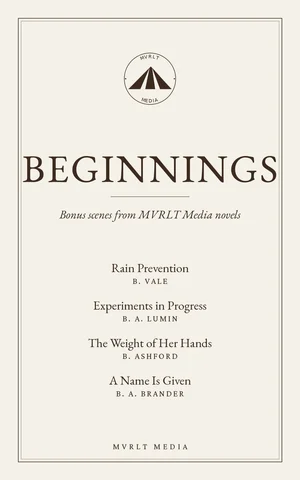
Beginnings collects bonus scenes from our novels into one short ebook. It is free, and it is how you will hear from us when the next book lands.
Get your free copy of Beginnings