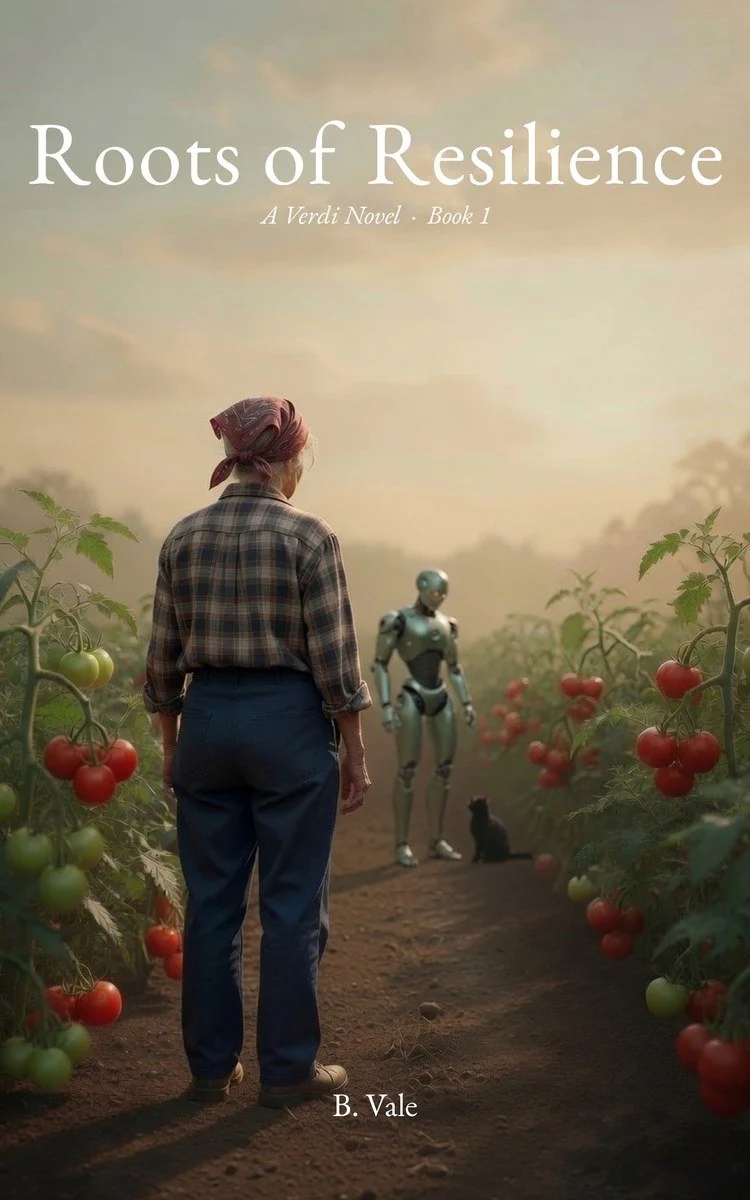
Roots of Resilience
A Verdi Novel · Book 1 · by B. Vale
Chapter 1: The Misguided Gift
The red tin can felt heavier than it used to, or perhaps Angela's wrist was just lighter, the bone aching with a dull, hydraulic pressure that signaled rain or a bad day. Or both. She ignored the warning shot from her joints and scattered the feed across the coop's dirt floor.
"Go on, then," she murmured.
The hens descended in a flurry of russet feathers and clucking. Red, the boldest layer, pecked sharply at a smaller hen, earning a tongue-click from Angela.
"Be nice. There's plenty."
Luna wove through Angela's ankles in a liquid figure-eight, her motor-purr vibrating against Angela's shins. The black tabby didn't care about the feed; she was just supervising the morning ritual, a task she took as seriously as Angela did.
Beyond the wire mesh, the garden breathed in the humid June morning. The rows were straight—her grandmother wouldn't have tolerated them otherwise—and heavy with dew. Zucchini leaves, broad as dinner plates, held water like jewels. The tomato cages groaned under the weight of vines stretching toward the sun. Angela wiped her hands on her faded bandana, her gaze drifting to the ancient oaks bordering the property.
Sometimes, standing here, she could almost feel the phantom weight of her grandmother's hand over her own, guiding the shears. Listen to the green, child. It talks if you stop making so much noise.
At the head of the tomato rows stood the oldest of them—the mother plant of the Cherokee Purples, grown from seed her family had saved every single year for ninety years. Nanny C had pressed the first of those seeds into Angela's palm when Angela was seven and folded her small fingers shut over them. These are the ones you don't sell, child. These you keep. Every other plant in this garden could fail and be sown again from a packet. Not this line. This was the one thing she could not buy back.
She crouched to check it, and a small wrongness stopped her hand. The leaves were a shade too dull; the first fruit had set a little too light. Nothing she could name. Nothing that matched the weather, or the feeding, or the water—all of which had been exactly what they should be. She had done everything right. For the first summer she could remember, the mother plant did not seem to know it.
A sharp throb in her knee brought her upright. She filed the worry away with the others and made herself stop looking at the plant. The pain medication she'd taken at four a.m. had long since resigned its commission.
"Mornin', Ange."
Bud's voice drifted from the back porch. He stood there in his soft, worn pajama pants and a Star Trek T-shirt that had seen better decades, an e-reader tucked under his arm. His hair, curling silver-blond at the nape of his neck, was a mess of sleep.
"You're out early," he called, though his voice was soft, scratching against the morning air.
Angela checked her watch. Seven-thirty.
"Not that early," she said, masking the stiffness in her voice as she latched the coop. "Garden doesn't wait for my beauty sleep."
Bud padded down the steps and across the lawn, the dew darkening his slippers. He smelled of Old Spice and dark roast coffee—the scent of the last thirty-five years. He pressed a kiss to her temple, lingering just a second longer than necessary. He was checking her temperature, the sly old fox.
"How are the girls?"
"Demanding." Angela nodded toward the tomatoes. "First Cherokee Purples are blushing. Another week, maybe two."
"Good thing. Saw Sarah Henderson at the post office. She asked if she needs to bribe you for a basket this year." Bud's eyes crinkled. "Said her husband is practically going through withdrawal."
Angela felt the corner of her mouth twitch upward. The waiting list at the Cookeville Farmers' Market was her vanity, her trophy. "Tell her patience is a virtue. And that I accept bribes in the form of peach cobbler."
Luna abandoned Angela's ankles to headbutt Bud's shin. He reached down, scratching the sweet spot behind her ears, and received a playful nip for his trouble.
"Violence," he cooed at the cat. "Pure violence." He straightened, looking at Angela with that specific expression—the suppression of a grin that threatened to break his face. "Coffee's ready. And... I've got something to show you."
Angela narrowed her eyes. "Bud DeLancy. What did you buy?"
"Think of it as an upgrade." He rocked back on his heels, vibrating with the energy of a man who had just discovered warp drive. "The future has arrived, Ange. FedEx just delivered it."
Delivered. The word settled in her stomach like cold oatmeal. Bud's "upgrades" usually involved rewiring something that worked perfectly fine until he touched it.
"I need to finish the walk-through," she said, clutching the feed tin a little tighter.
"Walk-through can wait twenty minutes," he said, turning back to the house. "Come on. Even Luna is invited."
Angela sighed, the sound lost in the rustle of the oaks. She moved through the garden beds first, unable to just leave. It was her kingdom, paid for in sweat and, lately, in the grinding erosion of her own bones. Since Dr. Shaw had given the CLL diagnosis a name three years ago—giving a shape to the exhaustion—Angela had clung to this dirt. The "watch and wait" strategy felt too passive. Here, she didn't wait. She grew.
But the humidity was already climbing, and her lower back was beginning to seize. She surrendered to the pain, just for a moment, and followed Bud inside.
The kitchen was a sanctuary of clutter and comfort. Her daily garrison of pills sat in the plastic organizer next to her plate. Bud had already poured coffee into her daisy-etched mug, the ceramic warm to the touch.
"Neuromancer again?" she asked, eyeing the cover on his screen.
"It holds up," Bud said, sliding into his chair. "Classic for a reason. Drink up. You'll need the caffeine for the unveiling."
"That sounds ominous." She swallowed her pills with a gulp of coffee—perfectly brewed, as always. "If this is another smart-composter that requires a Wi-Fi password to rot garbage, I'm putting it on eBay."
"Better." He leaned forward, eyes gleaming. "Gibson, Roddenberry... they knew, Ange. We're living in the prologue of the good stuff."
Angela took a bite of toast, skeptical. Technology, in her experience, was just a faster way to be frustrated. Her grandmother had managed an acre with nothing but a hoe, a calendar, and terrifying competence.
After breakfast, Bud led her to the garage with the ceremony of a magician. "Prepare yourself," he said, hand on the doorknob.
"I am prepared for disappointment," she muttered.
He threw the door open.
In the center of the concrete floor sat a crate aggressively large for a two-person household. The lid was off, packing peanuts scattered like dirty snow. And sitting inside, nestled in the foam, was a body.
No. Not a body.
It was green—a sleek, shifting botanical green—and human-shaped, though slightly smaller than Angela. Its face was a smooth, unblemished plate with two dark panels for eyes.
Angela stopped dead. The air in the garage felt suddenly thin. "What is that?"
"HomeBot," Bud said, his voice dropping to a reverent hush. "Agricultural package. Health monitoring upgrade. Top of the line, Ange." He circled the crate, touching the shiny casing. "It can lift, bend, haul—everything that's been wrecking your knees. It learns the terrain. It learns you."
A cold spike drove itself through Angela's chest. It sat there where her wheelbarrow should be. An interloper.
"I don't need a robot."
"You need help," Bud said, losing the showman's voice. He looked at her, really looked at her, in a way that made Angela want to hide her hands. "I see you, Ange. I see you wincing when you get up from the table. I hear you pacing at night when the aches won't let you sleep."
The truth was a slap. Angela looked away, focusing on a stain on the concrete. "I'm managing."
"You're suffering," he corrected gently. He reached out, his thumb brushing her weather-rough knuckles. "Let it take the heavy stuff. Just the heavy stuff. So you can do the part you love without... paying for it."
Without paying for it. The concept was seductive and terrifying. Gardening was the payment. The ache was the proof she was still doing it.
"It has amber eyes," Bud added, sensing her wavering. "Like the cat."
As if summoned, Luna hopped onto the edge of the crate. She sniffed the green plating, her tail flicking. She didn't hiss. She didn't bolt. She just rubbed her cheek against the machine's shoulder and sat down.
Traitorous animal.
"How much?" Angela asked. The retreat to practicality was her only defense.
"We had the fund," Bud said quickly. "For a rainy day. This is rain prevention."
Angela stared at the machine. It looked sterile. Soulless. But her knees were throbbing in time with her heartbeat.
"One week," she said, the words tasting like copper. "It's a trial run. And I'm the boss. It doesn't prune, pick, or water a single leaf unless I say so."
Bud beamed, the lines around his eyes softening. "Deal."
He reached into the crate and pressed a hidden stud at the base of the machine's neck. A low, harmonic hum filled the garage. The amber panels on its face flickered to life, glowing with a steady, warm light. The head turned, the movement fluid but undeniably hydraulic.
"Sequence complete," a voice said. It wasn't robotic, exactly—it sounded like a calm man speaking from the other end of a very clear phone line. "Hello. I am online."
"Hey," Bud said, waving. "I'm Bud. This is Angela."
The head pivoted to her. It was unnerving, being looked at by glass and sensors. "Hello, Bud. Hello, Angela. Awaiting primary directives."
Angela crossed her arms, bolstering her defenses. "Gardening. Heavy lifting. And you follow instructions exactly. No improvising."
"Understood, Angela. I am equipped with adaptive learning algorithms but will prioritize your direct input."
"Good. Because if you trample a peony, you're scrap metal."
"Noted."
Luna batted at the robot's arm. The machine looked down, processed the cat, and slowly extended a finger for her to sniff.
"We need a name," Bud said. "Can't just call him 'it.'"
"It's an appliance, Bud. We don't name the toaster."
"We call the toaster 'The Incinerator,'" Bud pointed out. "I was thinking Verdi. You know. Green."
The robot tilted its head. "Verdi. Italian for green. Also a renowned composer. Is this my designation?"
Bud grinned. "It fits."
"Designation accepted. I am Verdi."
Angela rolled her eyes, but the fight was draining out of her. "Fine. Verdi. Let's see if you're worth the crate you came in. Grab the shears. We're doing the roses."
The heat of the day had settled in, a wet blanket of eighty degrees that made Angela's shirt cling to her back. She marched toward the greenhouse's southern wall, tucking a frizzing curl behind her ear. Verdi followed three paces behind, moving with a silent, irritating grace.
The Queen's Guard roses were heavy with spent blooms, the pale pink petals browning at the edges. Deadheading was intimate work. It was cleaning, grooming, preparing.
"These are Queen's Guards," Angela said, stopping at the greenhouse's southern wall. "My grandmother planted the rootstock. They're older than you. Older than the internet." She laid two fingers against a thick, scarred cane, the way another woman might take a pulse. "And they're how I read this place. Nanny C watched the roses first—before the tomatoes, before the beans, before anything. When these start to sulk, the garden's fixing to hand you bad news a week before you'd see it anywhere else. You remember that."
"Rosa 'Pierre de Ronsard,'" Verdi supplied. "Introduced 1985. A vigorous climber requiring deadheading to encourage re-blooming."
Angela bristled. "Knowing the name isn't knowing the plant. Watch."
She took the shears from Verdi's hand—cold metal, firm grip. She found a spent bloom, traced the stem down to the first set of five leaves, and angled the blades. Snip.
"Forty-five degrees," she lectured. "Sloping away from the bud eye. Rain needs to run off, not sit and rot the stem."
Verdi leaned in, the amber eyes focusing—literally, she heard a tiny whir—on the cut. "The angle also promotes callus formation and directs auxin flow to the latent bud."
Angela paused. She knew how it worked; she hadn't thought about the chemical biology of it in years. "Yes. That. Your turn."
She handed the shears back.
Verdi stepped up. There was no hesitation. No squinting against the sun. The robot identified a withered flower, located the five-leaf junction, angled the tool, and cut.
Perfect.
It was clean. Too clean. It didn't obsess over avoiding a thorn; it simply knew where the thorn was.
"Acceptable," Angela said, trying not to sound impressed. "Again."
For an hour, she watched. It was efficient. It was tireless. And it made her feel utterly obsolete. Every time she lifted her arm, her shoulder clicked. Verdi moved like water pouring from a pitcher.
The heat pressed down. Angela leaned against a post, dabbing her forehead with the bandana. Her breath was coming a little short.
Verdi froze mid-snip. It turned, the amber eyes fixing on her chest.
"Angela," it said. "I am detecting elevated cortisol and a heart rate of one hundred and ten beats per minute. Skin temperature suggests overheating. Probability of heat exhaustion increasing."
Angela straightened, indignation flashing hot. "Don't you dare scan me."
"Health monitoring is a core protocol," Verdi said calmly. "I cannot disable it. I strongly recommend hydration and shade."
"I don't need a lecture from a glorified lawnmower."
"Ange?" Bud's voice floated from the porch. He was watching, of course. "Maybe listen to the robot? You look a little flushed."
She glared at the house, then at the machine. They were right, which was the most annoying part. Her head was swimming slightly.
"Fine," she snapped. "I'm taking a break. You... finish this wall. Don't touch the new buds."
She retreated to the porch, collapsing into her wicker chair. Bud handed her a glass of iced tea without a word. She drank it greedily, the condensation cooling her palm.
From the shade of the porch, she watched.
Verdi worked. It didn't stop to stretch. It didn't wipe sweat. It just worked.
Luna had migrated to the garden bench, sprawling in a patch of sun near the robot. She watched Verdi with half-lidded eyes. At one point, she stretched a paw out, resting it on the robot's leg while it pruned. Verdi didn't shake her off. It adjusted its stance, shifting its center of gravity to accommodate the cat without disturbing her.
Angela lowered her glass.
A minute later, a bumblebee—fat and fuzzy—landed on a cluster of roses Verdi was reaching for.
The robot stopped.
It held its hand perfectly still, the shears open, hovering inches from the bloom. It waited. The bee bumbled around, collecting pollen, taking its sweet time. Only when the insect buzzed away did Verdi complete the motion.
It wasn't efficiency. Efficiency would have been shooing the bee or working around it. Waiting was... deferential.
"Well," Bud said softly, following her gaze.
"It stopped for the bee," Angela murmured.
"Smart programming."
"Maybe."
Angela watched the green figure moving among her grandmother's roses. It wasn't natural. But neither was the titanium pin in her neighbor's hip, or the pacemaker in Bud's chest.
She rubbed her aching knee. For the first time all day, the pain felt manageable, simply because she wasn't currently exacerbating it. The roses were getting done. The garden was being cared for.
Maybe it wasn't an invasion. Maybe it was reinforcements.
"He does good work," Bud ventured.
Angela took another sip of tea, watching Verdi navigate a tricky cane without snapping a single thorn.
"He's passable," she conceded, the ghost of a smile touching her lips. "For an appliance."
"Passable is a start."
"Don't get cocky, Bud. He's got a week."
But as Verdi moved to the next bush, careful not to disturb Luna's nap, Angela settled back into her chair. She didn't have to get up yet. The roses were safe; the heavy work was getting done.
Her gaze drifted past the greenhouse to the head of the tomato rows—to the one plant she hadn't mentioned to Bud, to the dull green of leaves that had no business being dull. She watched it the way Nanny C had taught her to watch the roses: first, and longest. She still had no name for what was wrong with it. For the first time in months she had the leisure to simply sit and look at her garden, and what she found herself looking at was the one thing in it she couldn't explain.
Keep reading
Roots of Resilience
Or start with three free stories

Three Beginnings collects a bonus scene from each of our three novels into one short ebook. It is free, and it is how you will hear from us when the next book lands.
Get your free copy of Three Beginnings