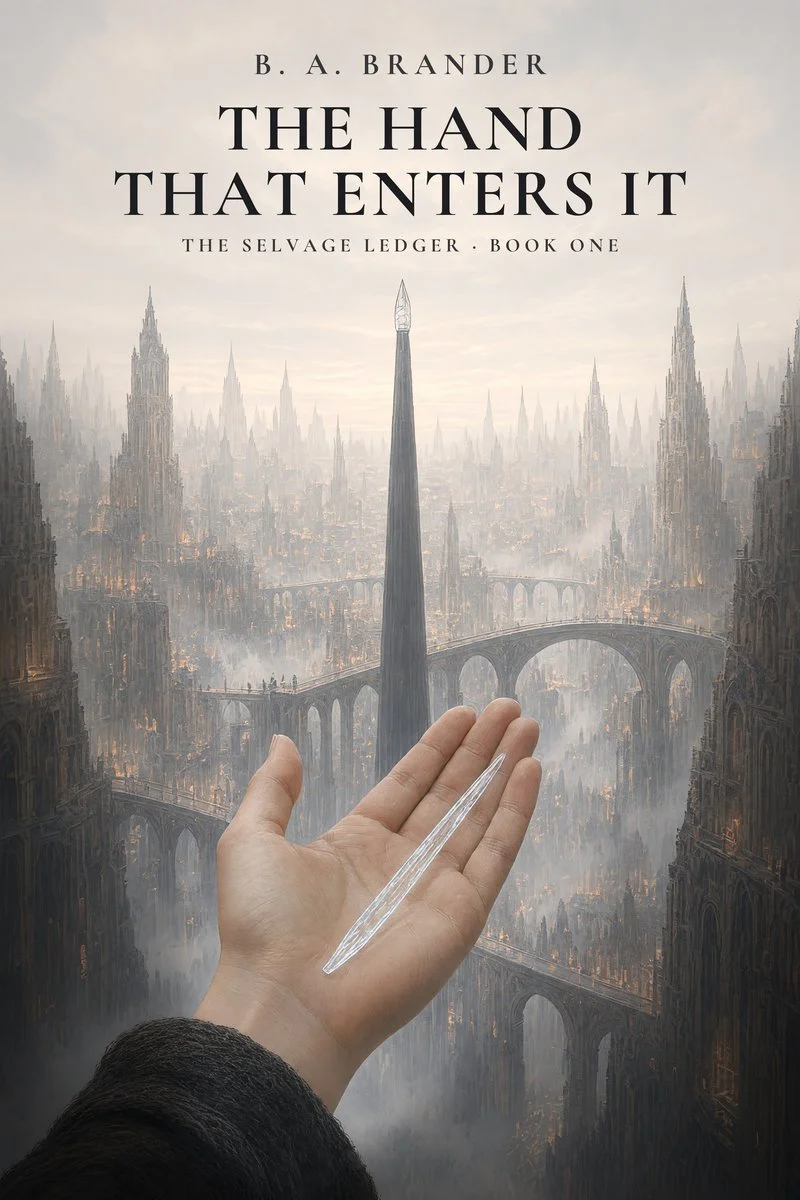
The Hand That Enters It: Chapter One
The Selvage Ledger · Book One · by B. A. Brander
The fall put me down on my knees on concrete, which was better than the last one.
I stayed there. The rule is that you stay down until you know which way is up and what is standing on it. The concrete was wet. It smelled of rust and of something cooked a long way off in a lot of oil. Above me, very high, there was a sound like a sea that had been taught to hum on one note, and under it, closer, a hiss of water running in a pipe I could not see.
The blade was hot against my hip. Not warm. Hot, the way it always was after, as if the iron had been through the fire again on its way down. I put my hand flat on the sheath and kept it there and turned my head, slowly, toward the place I had come through.
There was a wall behind me, close enough to touch, and light on the far side of it. The light came round the wall's edges in sheets of color, blue and then gold and then blue, and with each change I heard a woman's voice, enormous and soft, say something I could not make out. The tear was between me and the wall. I could not see it. Nobody can, unless it is open. But the blade could, and as I turned my hip toward the wall the heat in the sheath leaned that way like a dog that has smelled its own door.
Good. I knew where it was. I would know where it was until I left.
Then I looked for the ways out.
There were two. To my left the gap between the wall and the building beside it ran a dozen paces to a street, and the street was full of moving light and moving people. To my right the gap narrowed, and at the end of it there was a grille over a drain and a pile of something soft that had been rained on for a long time. Over me, nothing. Straight up, between the wall and the building, a slot of sky the color of a bruise, and across the slot, much higher than I could make sense of, the underside of a walkway lit along its edges.
I counted the floors of the building beside me until they went into the dark. Forty, and then I lost them. I was small here. I had been small before.
I got up.
The wall was not a wall. When I came round its edge I saw it was the back of a frame, black metal, three stories tall, and the light I had seen was a picture thrown onto its front from a box on a pole across the street. The picture was of a woman pouring water from a jug into a glass. The water ran and ran and the glass never filled. Every few breaths the picture changed to a single word in a script I could read: CLEAR. Then the woman again, and the water, and her soft enormous voice saying something about mornings.
Behind a picture of water, then. I would remember that.
I stood at the mouth of the gap with my back to the frame and watched the street for as long as I could without being noticed watching it.
* * *
People in that city walked fast and did not look at each other, and every one of them was drawing on something.
At first I saw only the crowd, thick and steady, coming down off the walkways by stairs and lifts and going along the street in two streams, one each way. Their clothes were plain, greys and browns and a deep blue, the blue, I guessed, of people who worked inside. Nobody wore a blade. Nobody carried anything larger than a bag that would sit flat against the body. The air was warm and damp, and it moved, all the time, in one direction, out of grilles at the foot of the buildings and up toward the sky, and the crowd walked through it without noticing it, the way you do not notice the sea if you were born beside one.
Then I saw the posts.
They stood at every corner and between the corners, waist-high, grey, with a dark glass face on the top. People touched them as they passed. Not everyone, and not every post, but enough that I began to count. A man touched one with the inside of his wrist and the glass glowed green under his hand, and a voice from the post said, quite quietly, "Draw recorded." A woman with a child on her hip did the same, and the post said it again. "Draw recorded." The child reached out to slap the glass too and the woman caught his hand and moved on without looking down.
It was not the touch that was being recorded. I worked that out from the woman with the child. When she was past the post she breathed in, deep, the way you breathe when you come up from under water, and the child on her hip did the same, copying her. She had not been short of air. Nobody on that street was short of air. But she had been told her breath was hers, and she took it.
There was a mark on the inside of every wrist I could see. A small square under the skin, darker than the skin around it. On the children too.
I looked at the inside of my own wrist. Nothing there but the old scar where a rope burned me when I was nine.
I could have gone back behind the picture and waited for the street to thin. But a city that counts every breath at every corner will notice a woman who stands in an alley all night, and it would notice her sooner than one who walked. So I walked. I came out of the gap into the stream going left, because left was where the light was brighter, and brighter light is where cities keep the things they want you to find.
Nobody looked at me. My clothes were wrong, but they were wrong in the way of someone poor, which is a way cities are used to. My coat had been made for weather in another world and it was too heavy for this air, and I was sweating under it inside fifty paces. A coat with a knife under it is a coat you keep on.
At the third corner the stream slowed. There was a post there like the others, but bigger, with a screen on its face as tall as a man, and people were stopping at it in ones and twos, touching it, reading something, moving on. A terminal. I let the crowd carry me close enough to read the screen over a man's shoulder, and it was a list. Names of places, I thought, with figures beside them. Sector 2. Sector 3. Sector 5. The figures were percentages, and some of them had a small mark beside them that pointed down.
The man in front of me touched the glass with his wrist and the screen changed to show something only for him. A line of figures. He read it, and his shoulders went down half an inch, and he said "Fine," to nobody, and went on.
Then it was my turn, and there was a woman behind me waiting, so I did what everybody else did. I reached out and laid the inside of my wrist on the glass.
The glass stayed dark.
"Unregistered person," the terminal said.
It did not say it loudly. It said it at exactly the volume it had said "Draw recorded" to every other wrist on that street, flat and clear, a voice with no age in it and no place. But it said it to me, and it went on.
"No allotment is drawn for you. Registration: Allotment Hall, ground floor."
I took my hand off the glass.
The woman behind me had heard it. I knew because she had stopped waiting. She was looking at me with an expression I had seen in two other worlds: not fear, not yet, and not interest. A kind of quick measuring, the look you give a stranger's dog. She did not say anything. She stepped round me and touched the glass, and it went green for her, and the voice said "Draw recorded," and she breathed in.
I turned away from the terminal before anyone else could look at me, and the first thing I saw when I turned was the spire.
It stood up out of the middle of the city, past the near towers, so tall that I had taken it at first for a different color of sky. Black. Thin at the top. At its very top a cap of glass that held a little light of its own, grey-white, like the last of a day. Every walkway I could see bent toward it. Every street, if you followed it far enough with your eye, ran down to its foot.
I knew what it was before I knew anything else about that city. Not from the journal. The journal had never seen this place. I knew it the way you know, walking into a strange house, which room the family sits in.
I started walking toward it, because it was where the voice had told me to go, and because it was where the light was.
* * *
I did not get there that evening. I meant to, but the city was larger than the spire made it look, and the streets that ran toward it did not run straight. After an hour I had crossed two walkways and gone down one long stair and the spire had not come any closer. My legs were shaking. They always shake, for the first day.
On the second walkway there was a tap.
It stood out from the wall at the walkway's end, a plain steel spout over a steel basin, with a post beside it and a short queue in front of it, five people, each with a bottle or a jug. I stopped across the walkway from it, by the rail, as if I were looking at the view, and watched, because I had two-thirds of a skin of water and no idea how this city gave it out.
A girl with a jug laid her wrist on the post. "Water," the post said. "Two measures remaining today." She held the jug under the spout and the spout ran, a clear steady stream, and stopped on its own when the jug was perhaps half full. "Water drawn. One measure remaining today." She went.
A man with two bottles. "Water. Four measures remaining today." He filled one. "Water drawn. Three measures remaining today." He filled the other. "Water drawn. Two measures remaining today." He went.
Then an old man with a tin can, a big one, the kind with a wire handle. He laid his wrist on the post and the post said, "Water. No measures remaining today," and he left his wrist where it was.
"That's not right," he said to it.
"Four measures drawn today," the post said. "Allotment: four."
"I've had two. I had two this morning. I had them at the tap on the low stair."
"Four measures drawn today," the post said, at exactly the same volume. "Allotment: four."
"Then somebody's drawn on my tag. Somebody's had two on me."
The post said nothing. He had not asked it anything.
"I said somebody's drawn on my tag."
"Draws are recorded at the wrist," the post said. "Four measures drawn today. Allotment: four. Next allotment at first light."
The old man stood there with his wrist on the glass and his can hanging from his other hand, empty. The woman behind him in the queue looked at the floor of the walkway. After a while he took his wrist off the post and said a word I did not know and went away along the walkway with his can, and the woman stepped up and laid her wrist on the post, and it said, "Water. Three measures remaining today," as if nothing had been said to it at all.
I looked at the water skin on my pack. The post would not know me. It would say to me what the terminal had said, in front of the queue.
I moved on.
There was a stair going down between two buildings, wide and open-sided, with landings every twenty steps, and on the landings people were sitting. I went down it until I found a landing where there was a corner nobody had taken, and I put my back into the corner and stood there.
Nowhere in that city was mine to sit. The air I was breathing on that landing was going up past me out of a grille in the wall, and somewhere it had been counted, and the count had been drawn against somebody's wrist. Not mine. When I breathed, I was breathing someone's margin. They would not notice. They would never know. I noticed.
I counted the people on the landing first. Seven. An old man asleep sitting up with his chin on his chest. Two women sharing a paper of something that steamed. A boy of about twelve playing a game on a small glass in his hand, his thumbs fast and his face still. A man in the inside blue with his eyes shut and his lips moving. A young couple, not speaking, her head on his shoulder, his eyes open and fixed on nothing. Seven, and me.
Then the ways off the landing. Up, the way I had come. Down, toward a sound of machinery and a warmer, wetter air. And a door in the wall, shut, with one of the grey posts beside it at waist height and a dark glass face. I would not be able to open that door. I counted it anyway. You count the doors you cannot open too. They are still doors.
Then I opened my pack.
I did not take it off. I swung it round onto my front and opened the top and put my hand in, and felt for what was in there without looking. Half a loaf of the bread from Tessary, hard as wood, and the dried fish. The two books, wrapped together in their oilcloth and tied with a cord, at the very bottom, where they always were.
I touched the knot on the cord, and it was as I had tied it, and I left it.
The tin was in the side pocket. I took it out. It was a small flat tin, made for sweets in a world that sold sweets in tins, and it had been mine long enough that the paint had worn off the lid where my thumb went. I opened it and counted the leaves without taking them out. Silver-grey, curled, dry. A sharp smell came up off them even unlit, like pine and like something burnt.
Twenty-six doses, if I kept them small.
I would need one soon. Not yet. I could feel the edges of the world beginning to fray, at the corners of my eyes, at the backs of my ears, a sense of the street above being a little too near and a little too far at once. It was not the bleed yet. It was only the landing. But it would come, and I wanted to know how long I could go before I needed the leaves. I wrote it in my head: day one, no dose yet. I would write it properly later, in the back of the ledger, where I keep the tally upside down so it does not touch the names.
I closed the tin and put it away.
Then I took the bread out and broke a piece off the end with my hands and ate it standing in the corner, with my back to the wall and the pack on my front and my eyes on the landing.
The boy with the game looked up at me once. I chewed. He looked back down.
The bread from Tessary was hard enough that it took a long time, and that was good, because it gave me something to do with my face while I listened. Below us the machinery went on. Above us, very far up, the hum. In between, the people on that landing breathed, and I breathed, and every few minutes someone came down the stairs or went up them and passed a post at the bottom or the top, and I heard it say "Draw recorded," quietly, as if it were counting sheep for somebody who could not sleep.
I ate half what I wanted, which is what I always eat on the first night, and put the rest away.
I did not sit. I did not take off my coat. I did not take off my pack.
The couple got up and went down the stairs together without a word. Six. The old man woke and looked at me for a long moment with his chin still low.
"You can sit," he said. "Nobody minds."
"I'm all right."
"Stand all night, then." He looked at my coat. "Hot for that."
"It's the one I've got."
He thought about that, or about something. "If you're new," he said, "the counter's quiet at the first bell. Ground floor. Right-hand wall. They give you a stool while you wait, if you look like you've walked." He shut his eyes again. "You look like you've walked."
"Thank you."
He did not answer. The boy with the game put the glass in his pocket and went up. Five.
The blade was cooler. Still warm, but cooler. I turned my hip a little to the left, toward where I thought the picture of water was, back the way I had come, and the warmth in the sheath followed my turning, faint, like a word said in the next room.
I stood in the corner of that landing until the people on it were three, and then two, and then only the old man and me, and I watched the lit stair above me and the dark stair below me and the door I could not open, and I did the sum I always do on the first night, which is not a sum at all, only a list of things I know.
I know where the tear is. I know where the ways out are. I know how much water I have and how much bread and how many doses.
I do not know how long this world will hold me.
And there is the line I do not need to open the book to read. I said it over to myself in that corner without moving my lips, the way other people say the words they were taught as children: With one in your hand you need not fall. I had been in two worlds before this one. In the first I had not known there was anything to look for. In the second I had found the book that told me, and then the world had let me go before I could look.
The old man was snoring. Up past the walkways the spire stood with its grey-white cap, and the light in the cap did not change.
My pack hung on my front, closed. At the bottom of it, under the shirt and the bread, the two books lay in their oilcloth together. I put my hand on the outside of the pack where I knew they were, and felt their edges through the canvas, the thin one and the thick one, and left them wrapped.