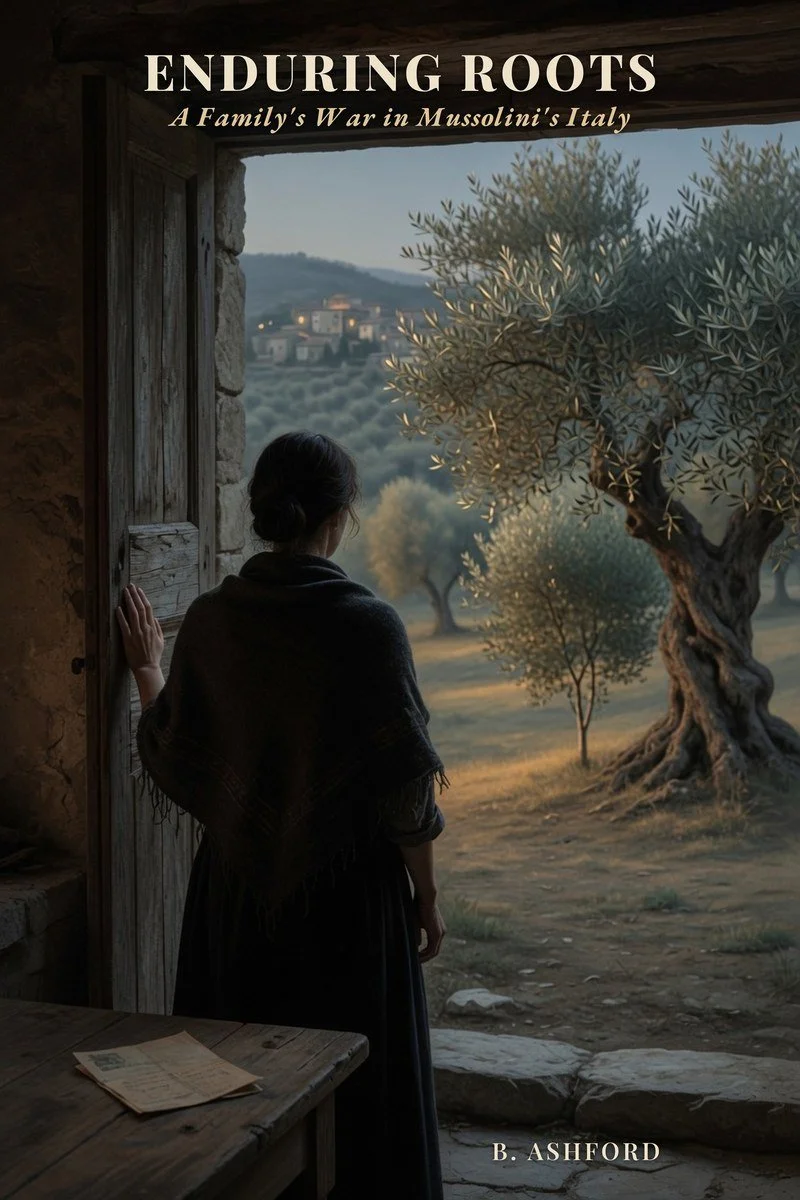
Enduring Roots
A Family's War in Mussolini's Italy · by B. Ashford
Chapter 1: Whispers of the Coming Thunder
Garlic sizzled in olive oil. Rosa minced basil from her resilient garden patch while steam curled off the simmering tomato sauce, and outside the shutters the village sat uneasy, waiting for news it did not want.
The kitchen door creaked open.
"The roads to Bergamo will be paved within the year, Mamma. Real asphalt, not these rutted cart paths we have endured since Papa's time."
Marco's boots struck the stone floor with military precision, Giovinezza on his lips again—that tune had taken up permanent residence in him these past months. Rosa recognized the party anthem without looking up.
"Il Duce understands what this country needs," Marco continued, settling beside the radio. "Employment for every willing man. Look at what we have accomplished in Africa."
Rosa's knife paused. The radio had crackled with reports from Ethiopia for months, static-filled dispatches reaching their village like distant thunder. She resumed cutting, each stroke deliberate.
"Jobs are good," she replied, her voice smoothed to the careful neutrality of a woman who had learned to navigate dangerous conversations. "Your father would have welcomed steady work."
Marco adjusted the radio's dial. The announcer's voice emerged from the wooden speaker positioned between Rosa's ceramic pitcher and her late husband's photograph.
"The successful advance under General Graziani demonstrates Italian military superiority and the righteousness of our civilizing mission."
The words filled the kitchen, thick and close. Rosa's knife worked through the oregano stems while she measured the triumphant language against what she already knew: men dying in distant deserts, families receiving telegrams that shattered their worlds.
"Righteousness," she murmured.
Marco's head turned. "What?"
"Nothing, caro."
Her silence carried weight. Marco's enthusiasm sharpened.
"This is not like the last war, Mamma. This time we fight for civilization itself. We are bringing light to people who have lived in darkness."
Rosa scraped the chopped herbs into a bowl, their fragrance mingling with the heavier scent of the sauce. She had attended enough funerals to know that mothers' tears tasted the same regardless of which flag their sons followed.
"Lucia will be home soon. She has been working late again."
"Helping the schoolmaster with the little ones," Marco said with satisfaction. "Finally, lessons that prepare them for the world they will inherit instead of filling their heads with outdated ideas."
The radio's triumphant music, punctuated by distant chanting, set Marco's fingers tapping against the table in time with the military cadence.
Through the window, Rosa glimpsed new posters on the main street: "Credere, Obbedire, Combattere" beneath Il Duce's stern profile.
"Your father used to say," she began, her back turned to Marco, "that a man's worth was not measured by how loudly he shouted his beliefs."
Marco's tapping stopped. "Papa lived in simpler times. Sometimes you need strong voices to cut through confusion."
Silence settled, broken only by the bubbling sauce and distant children's laughter. Rosa retrieved a bottle of wine her husband had laid down years before his death.
"Will you stay for dinner?"
"I cannot. There is a gathering in Brescia, important discussions about the region's future." Marco straightened his shirt. "I will return tomorrow."
After he left, Rosa stood cradling the wine bottle. The radio continued broadcasting, but she listened instead to the sounds beyond: horses' hooves on cobblestones, vendors calling their evening bargains, children's games increasingly influenced by the weekly military parades.
In her garden, the olive trees her grandfather planted stood as an anomaly this far north, where the climate sat at the edge of what the fruit could tolerate—hardier stock he'd chosen deliberately, coaxed from ground that should have been too cold for it. They still bore silver-green fruit against the failing light, while the radio behind her promised a different kind of harvest.
Rosa's feet found their habitual path between the trunks, flattened by decades of the same walk. She stopped at the oldest one, its bark rough as her husband's calloused palms had gone in his final years—this patriarch had outlived three killing frosts that claimed the neighboring groves, its roots reaching deeper than the ground should have allowed. Behind her, warm light spilled from the kitchen window and belonged to another world—one where sons argued over distant wars while mothers counted costs in spoonfuls of rationed flour.
Crickets began their evening symphony. Approaching footsteps caused her to turn, recognizing Enzo Torretti's gait before his weathered face emerged from the shadows between trees.
"Evening, Rosa," he said, weariness marking his voice since radio broadcasts began promising glory while local shops struggled to stock their shelves. "Beautiful night for walking among old friends."
He gestured toward the grove, leaves turning in the evening wind.
"They have weathered worse troubles," Rosa replied, though her words felt less certain than intended.
Enzo nodded, his expression troubled. He glanced toward the village where electric lights flickered in windows, his hands working at something in his coat pocket.
"Perhaps. Though I wonder if even these ancient witnesses could have imagined our particular storm."
Tightness in Rosa's chest accompanied conversations venturing into dangerous territory. "All generations face troubles. Our children will find their way."
Enzo's laugh carried bitter edges. "Will they? Word comes from the cities of new laws being drafted. Laws making certain people enemies for their grandparents' blood alone."
The words were out now, delicate and dangerous to touch. Rosa's pulse quickened.
"What laws?" she whispered above the cricket song.
Enzo withdrew his hand, pressing folded paper against his thigh. His eyes darted toward the village, scanning for observers.
"Laws against Jews, they say. Against anyone the government decides does not belong in the new Italy." His voice dropped. "Businesses are being marked, families forced to register."
Rosa catalogued faces she knew: shopkeepers, teachers, Dr. Goldstein who had delivered her younger children and saved Lucia from pneumonia. His gentle hands had never threatened anyone's vision of greatness.
"Surely only rumors."
"Perhaps." Enzo's expression suggested little faith. "But frightened people prepare for possibilities. Some remember what happens when neighbors become strangers overnight."
Church bells called evening vespers, their bronze voices carrying across the valley with centuries of authority. Tonight the chimes asked questions instead of answering them.
"I should return. Lucia will worry."
Enzo made no move to leave. Instead, he extended the folded paper. "Sometimes information finds its way to people who need it. Good neighbors share what they have learned."
Rosa stared at the paper as if it might transform into a serpent. She understood the implications: movement from passive observation into active participation in matters that endangered her family.
"I do not read such things, Enzo. I keep house and mind my children's welfare."
"Of course." The paper remained extended. "Though sometimes minding children's welfare requires understanding the world they will inherit."
Truth pressed against Rosa's resistance like water against cracking stone. Marco's enthusiasm had curdled from youthful idealism into something closer to willful blindness. Lucia's growing tension suggested awareness of unnamed but urgent threats.
"What does it contain?"
"Names. Places where people have disappeared. Stories newspapers will not print." His eyes met hers directly. "Truth, Rosa. The kind that might help someone make better choices about whom to trust."
Rosa's fingers closed around the paper before she decided to take it. Ordinary newsprint, the kind that might carry weather reports—yet it dragged at her hand like something forged of iron.
"You gave me nothing," she said, surprising herself with her firmness. "We spoke of weather and crops."
Enzo's weathered face creased into what might have been a smile. "Of weather, yes. And storms wise farmers prepare for before they arrive."
After he left, Rosa stood alone beneath the branches, the paper crinkling as she slipped it into her apron pocket. The first stars appeared in the deepening sky, their light filtering through leaves into patterns that shifted with each breeze.
When she finally walked toward the house, her steps followed the same path her own feet had flattened over decades. But the woman moving along that route carried knowledge that transformed the landscape around her, turning safe harbor into another frontier where the price of neutrality might soon exceed her ability to pay.
The hearth fire's amber light illuminated sepia-toned family portraits on worn stone walls, silent sentinels from generations past.
Giovanni shifted in his chair, hands nervous in his jacket, worry etched in his eyes by firelight.
"There is something I need to tell you all," he said formally. "Something I have considered for weeks."
Rosa's hands stilled on her mending, recognizing the gravity. Marco looked up from his pamphlet, interest sharpening. "Good news, I hope," he said, setting it aside. "The country offers more opportunities each month for young men willing to contribute to national renewal."
Lucia remained silent in her corner chair, but her posture shifted toward attention. She had been reading Carducci, verses speaking of Italy's ancient greatness without mentioning current politics. Her finger marked her place between pages while her eyes fixed on Giovanni's face with disturbing intensity.
Giovanni withdrew his hand, revealing a small velvet pouch darkened to the color of dried blood by age. Rosa recognized the container immediately; it had belonged to her own mother, and her mother's mother before that, kept through the years in the cedar chest at the foot of Rosa's bed.
"I have arranged to travel to America," Giovanni said, the words falling into the firelit space like stones dropped into still water. "A man in the next village has family in New York who can provide work and lodging. The ship leaves Naples in six weeks."
Silence expanded until it filled every corner, pressing against walls and settling between family photographs. Rosa's needle slipped, pricking her finger sharply enough to draw blood that beaded bright red against her work-worn skin.
Marco's pamphlet crinkled as his hands tightened. "America? Now? When Italy stands on greatness's threshold unlike anything witnessed since the Caesars?"
The fire popped, sending sparks up the chimney and briefly illuminating each face: Rosa's careful neutrality cracking to reveal fear beneath, Marco's confusion transforming into anger, Lucia's studied composure hiding calculations moving behind dark eyes.
"America offers steady work," Giovanni said, gaining strength. "Factories paying wages sufficient to send money home, opportunities to build something lasting rather than waiting for promises that may never arrive."
Marco stood abruptly, the chair scraping against stone. "Promises? You call roads, employment, national pride mere promises? You speak like someone who has forgotten what being Italian means."
"I know exactly what being Italian means," Giovanni replied, his tone level despite his brother's heat. "It means watching neighbors choose between bread and rent. Seeing young men with strong backs idle because no work exists for willing hands."
The velvet pouch pulsed in Giovanni's palm, drawing Rosa's attention despite the escalating argument between her sons. She remembered her mother showing her the necklace it contained, silver links delicate as spun moonlight connecting a pendant carved with Saint Christopher's image, blessed by generations of priests.
"Il Duce has created employment projects transforming Italy into a modern industrial power," Marco said, stepping closer until firelight painted his face bronze and shadow. "Men leaving now abandon their duty to participate in this glorious restoration."
Lucia's book closed with a soft whisper of pages, barely audible yet somehow significant enough to draw both brothers' attention.
"Perhaps," she said with careful deliberation, "different kinds of service exist. Some serve by building, while others bear witness to what lies beyond our borders."
Marco turned toward her, disappointment mingling with anger. "Bearing witness? Is that what we call fleeing? Abandoning the Fatherland when it needs every son's strength?"
Giovanni opened the velvet pouch with movements suggesting reverence mixed with reluctance. The silver necklace spilled into his palm, the chain catching firelight and sending dancing reflections across the stone walls. The Saint Christopher pendant swayed gently, its carved features softened by decades of faithful fingers.
"I am not fleeing," Giovanni said quietly. "I am seeking opportunity that does not exist here, work that allows me to help our family prosper rather than merely survive."
He cradled the necklace in his open palm, his gesture tentative but determined. "Mamma, this was Nonna's—your mother's. If I must cross the ocean, let me carry it, so that a piece of home travels with me and finds its way back again."
Rosa's breath caught as she recognized not just the necklace but the memory it carried. Her own mother had pressed the same silver chain into her palm during the terrible summer when influenza swept the village. Keep this safe, she had whispered through fever-cracked lips. When your children face hard choices, let it remind them they carry the strength of every woman who came before them.
"Nonna understood that families scatter sometimes," Giovanni continued, his voice softening. "That doesn't mean they're lost."
Marco's hands clenched. "Men who leave don't come back. A year, and the village has forgotten their names."
"Or they build something better than what they left," Lucia said quietly.
Rosa closed her hands around her son's, the silver warm between their palms, metal that had anchored generations of family prayers and now carried this one—hope and fear both, sealed into the chain that would cross an ocean with him.
"My mother wore this all through the last war," Rosa said, her voice catching on memories. "She said Saint Christopher had carried our men home from battles where good men died for reasons they could not understand."
She lifted the necklace toward the firelight, watching the pendant turn as it caught the dancing flames. Saint Christopher's serene expression offered comfort transcending this moment.
"But she also said true protection came not from silver or saints, but from carrying love in your heart and remembering those who share your blood."
Marco's posture remained rigid, yet something softened as he watched his mother's ritual handling of the family heirloom.
"How long before you return?"
Giovanni's silence stretched beyond comfort, filled with implications none wanted to examine. The fire settled, sending another shower of sparks up the chimney.
"I do not know. Years, perhaps. However long it takes to establish something solid enough to justify this sacrifice."
Rosa pressed the necklace back into Giovanni's palm and folded his fingers over it, the movement both ceremonial and practical. "Wear it under your shirt, close to your heart," she said. The silver had warmed quickly between their hands, and she remembered her mother's fingers fastening the same clasp countless Sunday mornings.
"Then you will carry our blessing," she said, her voice gaining strength from maternal authority that transcended political divisions. "Go with God, figlio mio. This house will be standing when you come back to it."
She stood and moved toward Giovanni, arms opening for an embrace that already knew it was a farewell. Worry had whittled him down to the boy who once sought comfort from thunderstorms, smaller than memory kept him.
"Find freedom for us all, brother," Lucia whispered, rising to add her arms to the family embrace. "And write faithfully so we know you are safe."
Marco remained apart momentarily, his internal struggle visible across his face. Finally, he stepped forward, encircling them all in a gesture that spoke of love persisting despite ideological differences.
"Write of American prosperity," he said quietly. "But do not forget Italian pride."
The fire crackled while light painted the embracing family in gold and amber, one more image for the wall's collection of survival and separation. Outside the shutters, the village settled into evening quiet, broken only by distant church bells and the wind combing through the olive groves.
Keep reading
Enduring Roots
Or start with three free stories
Three Beginnings collects a bonus scene from each of our three novels into one short ebook. It is free, and it is how you will hear from us when the next book lands.
Get your free copy of Three Beginnings